
You find a product for $10 from a dropshipping supplier and list it in your store for $30.
That’s a $20 profit, right?
Not quite.
Even when your supplier handles shipping directly to the customer, there are still costs to account for. Shipping fees, packaging, payment processing, and advertising can all take a share of that $20.
By the time the order is delivered, you may be left with much less than you expected.
That’s why understanding dropshipping costs matters before setting your prices. Whether you’re launching your first Shopify store or reviewing an existing product, knowing what each order actually costs can help you make better decisions.
Let’s break down the expenses, calculate a sample order, and see what they mean for your profit margins.
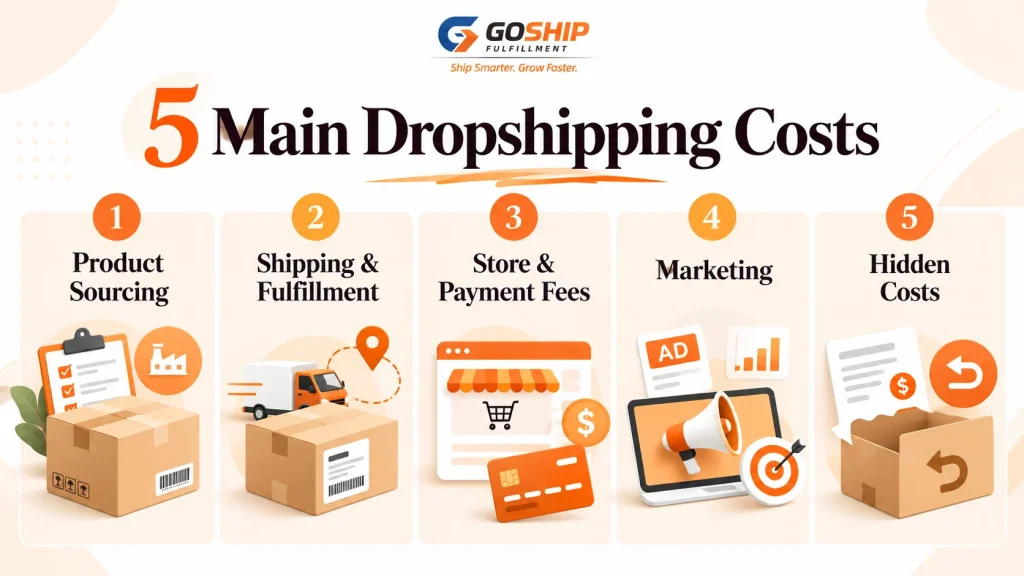
What Are the Main Dropshipping Costs?
Dropshipping generally allows you to start selling without purchasing large amounts of inventory upfront. But there are still costs to account for, both when an order comes in and when you’re running your store.
Here’s where those expenses typically come from.
1. Product Sourcing Costs
The starting point is the price your supplier charges for the product.
Depending on your arrangement, the quote may cover the product alone or include services such as packaging and shipping. It’s worth checking exactly what’s included before comparing suppliers.
You may also spend money on samples, product inspections, or customization. If you decide to buy inventory in bulk, minimum order quantities (MOQs) and upfront purchasing costs become relevant too.
A lower unit price can be attractive, but it isn’t necessarily the better deal if it requires more inventory than you’re ready to manage.
2. Shipping and Fulfillment Fees
Even when your supplier ships orders directly to customers, someone still has to pay for delivery.
Shipping costs can vary with parcel weight, dimensions, destination, delivery method, and product restrictions.
Depending on the provider, fulfillment charges may cover:
- Picking and packing
- Packaging materials
- Special handling
- Inventory storage, where applicable
- Shipping and tracking services
Some suppliers bundle these services into one price, while others charge separately.
For example, a $4 shipping quote that excludes handling and packaging may cost more overall than a $5 quote that includes both.
The important thing is to compare the total cost of getting one order to your customer, without counting any included services twice.
3. Store and Payment Fees
Your store has expenses even before you make a sale.
Platform subscriptions, domain registration, paid themes, and ecommerce apps can all contribute to your operating costs.
Payment processing fees work differently. They’re generally charged according to the transaction and your payment provider’s pricing terms.
For a realistic profit calculation, distinguish between fees charged on individual orders and recurring expenses that need to be covered by your overall sales.
4. Marketing and Customer Acquisition
Attracting customers can be another significant expense, especially if you rely on paid advertising.
For example, if you spend $80 on ads and receive ten orders attributable to those campaigns, that’s an average advertising cost of $8 per order.
Your actual results will vary, but the principle stays the same: advertising expenses reduce the amount you keep from each sale.
Organic traffic may reduce your dependence on paid ads, although content creation and SEO still require time and resources.
5. Returns, Customs, and Other Hidden Costs
Not every expense is predictable.
Refunds, replacement products, returned parcels, and address corrections can all create additional costs.
International orders may also involve customs duties, taxes, or clearance fees. Who pays them depends on the destination, shipping terms, and applicable requirements.
You won’t necessarily face these charges on every order. Still, allowing for occasional problems can give you a more realistic picture of your margins.
How to Calculate Dropshipping Costs Per Order
Let’s see how these expenses affect a single order.
Suppose you sell a product for $30 through your online store. Your supplier charges separately for the product, shipping, and packaging.
Here’s a hypothetical cost breakdown:
| Cost Item | Amount |
| Selling Price | $30.00 |
| Product Cost | $10.00 |
| Shipping and Fulfillment | $5.00 |
| Packaging | $1.00 |
| Payment Processing | $1.50 |
| Advertising Cost per Order | $8.00 |
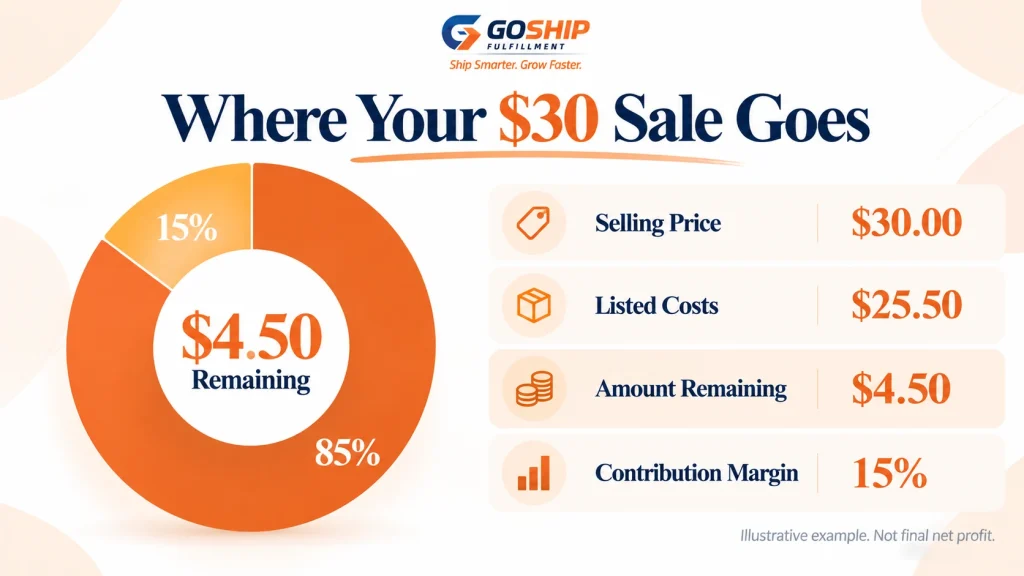
| Amount Remaining | $4.50 |
These figures are illustrative, not actual supplier quotations or industry averages. Packaging is charged separately in this example.
After the listed costs, $4.50 remains from the $30 sale—a contribution margin of 15%.
This isn’t your final net profit. Store subscriptions, other operating expenses, and any additional costs still need to be considered.
Contribution per Order = Selling Price − Variable Order Costs
In this example, the $8 advertising cost is an average allocated to each order, rather than a fixed charge on every transaction.
If shipping rises by $2, the amount remaining drops to $2.50. That’s roughly 44% less contribution from the same sale.
How to Manage Dropshipping Costs for Different Products
Two products with the same supplier price won’t necessarily cost the same to ship.
Beyond weight and size, packaging needs, handling requirements, and shipping restrictions can all affect the final cost. This is particularly relevant for products such as dietary supplements, cosmetics, and perfumes.
Dietary supplements may require additional attention to labeling, batch information, expiration dates, and storage conditions. If you’re holding inventory, stock rotation and expiration management can add to operating costs.
Cosmetics and skincare can present different challenges. Glass bottles and liquid products may need extra protection against breakage or leakage, increasing packaging materials and parcel weight.
Perfumes and fragrances can be more complicated to ship, especially alcohol-containing products that may be classified as dangerous goods. Available shipping services, packaging rules, and documentation requirements depend on the product and destination.

These differences don’t necessarily make a product unsuitable for dropshipping. They do mean that a basic product quotation may not tell you everything you need to know.
Before committing to a product, a few practical checks can help:
- Compare quotes on the same basis. Check the total delivered cost for the same product, destination, and packaging requirements.
- Choose appropriate packaging. Protect fragile products without adding unnecessary weight or oversized materials.
- Check shipping availability. Make sure suitable delivery services are available for your product and target destinations.
- Review samples and product requirements. Identify potential quality or handling issues before scaling.
- Track unexpected expenses. Use actual shipping adjustments, refunds, and replacement costs to update your calculations.
- Clarify responsibilities and pricing terms. Ask who pays for damaged or undelivered orders, and whether costs change with order volume.
Final Thoughts: Know Your Costs Before Setting Your Price
The difference between your selling price and your supplier’s quote isn’t always what you take home.
Shipping, payment fees, advertising, and unexpected charges can quickly change the numbers. A realistic cost calculation helps you set prices with a clearer understanding of what each sale contributes to your business.
If you’re exploring sourcing and fulfillment options, GoShipFulfil can help you review product, packaging, and shipping requirements for your target markets.
Share your product details and expected order volume to discuss a suitable quotation.