A customer orders a 100ml perfume. A few days later, the package arrives—but inside is the 50ml version.
Now you have a customer asking for a replacement, another parcel to arrange, and an extra shipping bill.
It’s a small mistake with consequences that can quickly add up.
That’s why order accuracy matters in ecommerce. Getting the right products into the right packages isn’t just a warehouse task. It affects customer satisfaction, operating costs, and how confidently your business can handle more orders.
So, how do you measure order accuracy, and what can you do when mistakes keep happening?
What Is Order Accuracy?
Order accuracy measures the percentage of customer orders fulfilled without errors.
An accurate order contains the correct products, quantities, and variants, prepared according to the customer’s order and the agreed packing instructions.
For example, if a customer orders two skincare products but receives only one, or receives the wrong size, the order would be considered inaccurate.
Order accuracy is different from product quality. A product can pass inspection and still be sent to the wrong customer, while a correctly packed order may contain a defective item.
These issues require different checks during the fulfillment process.
How to Calculate Order Accuracy Rate
Knowing what counts as an order error is the first step. The next is finding out how often those errors happen.
You can measure this using the order accuracy rate, which shows the percentage of orders fulfilled correctly during a given period.
The formula is:
Order Accuracy Rate = (Accurate Orders ÷ Total Fulfilled Orders) × 100
Count each order only once. If an order contains one or more fulfillment errors, it should be recorded as an inaccurate order.
Let’s say your online store fulfilled 500 orders last month, and ten of them contained errors.
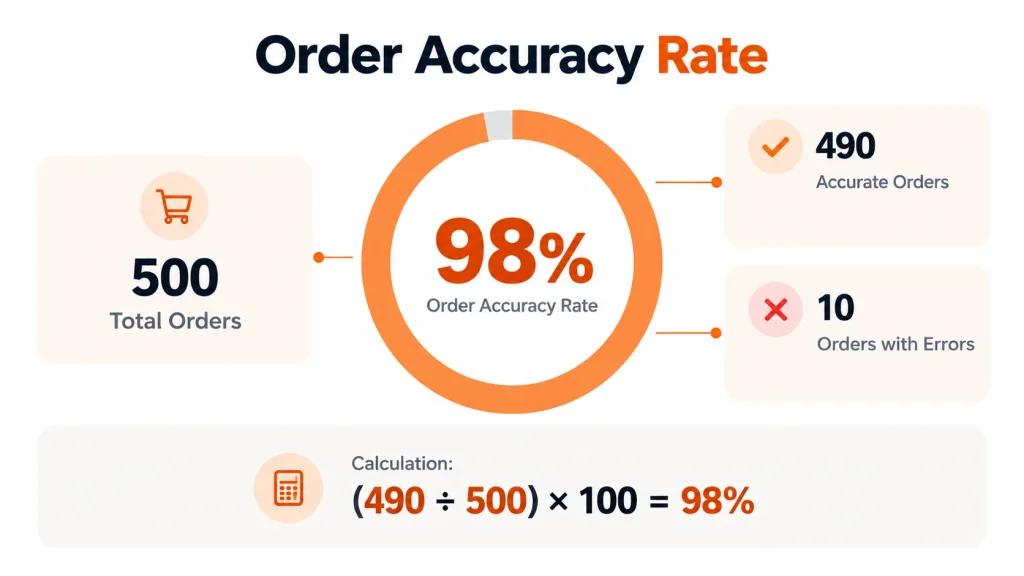
| Order Data | Number |
| Total fulfilled orders | 500 |
| Orders with errors | 10 |
| Accurate orders | 490 |
| Order accuracy rate | 98% |
(490 ÷ 500) × 100 = 98%
So, 98% of your orders were fulfilled without errors.
That sounds pretty good. But if your business grows to 5,000 orders while maintaining the same accuracy rate, you’d be dealing with 100 incorrect orders.
The percentage hasn’t changed, but the number of customers affected has increased significantly.
What Is a Good Order Accuracy Rate?
Ideally, you want your order accuracy rate to be as close to 100% as possible. But what counts as a good result depends partly on your business and fulfillment operations.
A store selling a few simple products may face different challenges from one managing hundreds of SKUs, multiple variants, and customized bundles.
Rather than relying on a single industry benchmark, start by tracking your own performance over time.
For example, if your accuracy rate drops from 99% to 97%, look at what has changed. Have you added more product variants? Has order volume increased? Have you changed your packing process?
These questions can help you identify where errors are occurring and what needs attention.
Why Order Accuracy Matters for Ecommerce
A 98% accuracy rate may look reassuring, but the remaining 2% can still create problems beyond the warehouse.
Extra fulfillment costs
Correcting an incorrect order may involve replacement products, additional shipping, return handling, and customer support.
Even when the customer doesn’t need to return the wrong item, sending a replacement still costs money.
Customer frustration
Customers expect to receive what they ordered.
A missing item or incorrect variant can be especially frustrating when the purchase is intended for a particular occasion or needed by a specific date.
Inventory discrepancies
Fulfillment errors can also affect inventory records.
If a warehouse ships the wrong SKU but records the originally ordered SKU as dispatched, the system may no longer match what’s physically available.
Over time, these discrepancies can make inventory management and replenishment planning more difficult.
The more orders you handle, the more important it becomes to identify where mistakes happen and prevent them from recurring.
What Causes Order Fulfillment Errors?
Order errors don’t always start at the packing table. Some happen much earlier, when product information or order instructions aren’t clear.
Similar Products and SKU Confusion
Imagine a cosmetics store selling the same moisturizer in three sizes. The bottles look almost identical, with only small differences in their labels.
Without clear SKU identification, it’s easy to select the wrong version.
The same issue can arise with perfume sizes, skincare shades, supplement flavors, or products with similar packaging.
Picking and Packing Mistakes
A warehouse worker might select the correct product but pack the wrong quantity.
Multi-item orders create more opportunities for mistakes, especially when products must be collected from different storage locations.
Incorrect Order Information
Not every error begins in the warehouse.
Outdated product mapping, incorrect SKU information, or unclear order updates can cause problems before anyone starts picking products.
If customer changes aren’t communicated properly, the fulfillment team may prepare an order using outdated information.
Unclear Packaging Instructions
Customized orders introduce another layer of detail.
A brand might require a specific product insert, branded box, or promotional bundle.
If those instructions aren’t clearly documented, the correct products may still arrive in the wrong configuration.
This is particularly relevant for private label brands and sellers offering gift sets or bundled products.
How to Improve Order Accuracy
Many of these errors can be reduced with clearer product information, consistent packing procedures, and checks at the right stages.Improving order accuracy doesn’t necessarily require a complete warehouse overhaul. Often, clearer information and a few well-placed checks can make a difference.
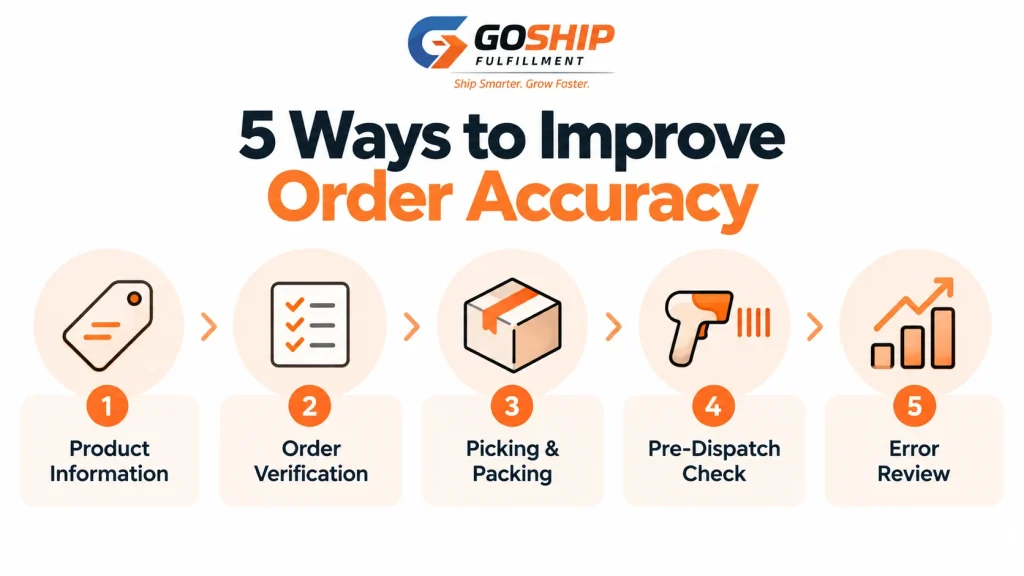
1. Keep Product Information Consistent
Give every product variant a distinct SKU and make sure the same identifiers are used across your store, supplier records, and fulfillment instructions.
Product names should also be specific enough to distinguish similar items. For example, “Perfume — 100ml” is more useful than simply “Perfume” when several sizes are available.
2. Verify Orders Before Picking
Check that order details are complete and accurate before they enter the picking process.
This includes product variants, quantities, customer updates, and any special instructions.
If an order contains conflicting information, resolving it before picking is usually easier than correcting a parcel after dispatch.
3. Use Clear Picking and Packing Instructions
Packing instructions should explain exactly what belongs in each order.
For bundled products, list every included item rather than relying only on the bundle name.
Where appropriate, barcode scanning or other verification tools can help teams match selected products with order records.
Whatever method you use, make sure the instructions are clear and followed consistently.
4. Check Orders Before Dispatch
A final check provides another opportunity to catch mistakes before an order leaves the warehouse.
Depending on the product and packing requirements, this might involve confirming SKUs, quantities, variants, shipping labels, and packaging details.
The goal is simple: make sure the contents of the parcel match the order before it’s dispatched.
5. Record Errors and Look for Patterns
Don’t just correct an incorrect order and move on. Record what happened.
Was the wrong SKU selected? Was an item missing? Did the order contain outdated information?
Reviewing these issues regularly can help you identify recurring problems.
If mistakes often involve similar-looking products, clearer labels or better storage arrangements may help. If errors mainly occur with promotional bundles, the packing instructions may need improvement.
What to Ask Your Fulfillment Partner About Order Accuracy
These steps are useful whether you handle fulfillment yourself or work with a third-party provider. But when another team is preparing your orders, clear communication becomes just as important as the checks themselves.
Before working with a fulfillment partner, make sure both sides understand how orders will be received, prepared, and checked.
A few questions are worth asking:
- How are product variants and SKUs verified? Confirm how similar products, sizes, and quantities are identified during fulfillment.
- How are custom packing instructions handled? For bundles, gift sets, or branded packaging, agree on the contents and requirements before shipping begins.
- What happens when an order error is reported? Discuss how missing items, incorrect shipments, and customer complaints will be reviewed and resolved.
For example, if you’re selling a skincare gift set containing three products, both sides should agree on exactly what belongs in the package before the first order is dispatched.
If you’re considering GoShipFulfil as your fulfillment partner, you can discuss your product specifications, packaging requirements, and the checks needed for your orders before agreeing on a workflow.
Final Thoughts: Small Errors Deserve Attention
Order accuracy is more than a percentage. It helps you see how reliably your fulfillment process is working.
Start by measuring your current rate, identifying recurring mistakes, and improving the checks that matter most.
As order volumes grow, review your results regularly and make adjustments where needed.
If you’re planning to outsource fulfillment or review your current order process, contact GoShipFulfil with your product and packing requirements to discuss a suitable arrangement.