Want to start an online store without filling your spare room with unsold products? You’ve probably come across two options: print on demand and dropshipping.
Both let you sell products without keeping inventory yourself. A supplier handles the physical orders, while you focus on running your store.
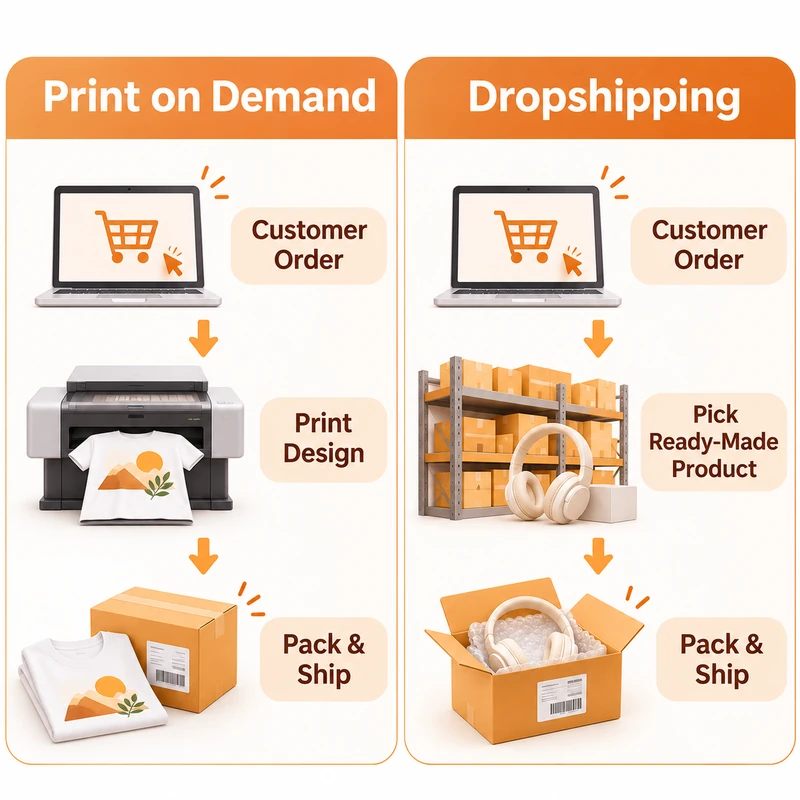
But there’s an important difference. With print on demand, products are customized after someone orders them. With traditional dropshipping, you’re usually selling products that already exist.
That difference affects what you can sell, how much you spend, and how quickly orders can reach customers.
So, print on demand vs dropshipping—which makes more sense for your business? Let’s compare them.
What Is Print on Demand?
Print on demand (POD) lets you sell custom-designed products without producing or stocking them in advance.
You can add your own artwork or text to products like T-shirts, hoodies, mugs, and tote bags. When someone places an order, your supplier prints the design onto the product and ships it directly to the customer.
For example, imagine you want to sell T-shirts featuring your own illustrations.
You upload a design to your store and list the shirt for $30. A customer buys it, and your POD supplier prints your artwork onto a blank T-shirt, packs it, and ships it.
If the supplier charges $18 for production and shipping, you have $12 left before other expenses, such as payment processing fees, advertising, and taxes.
The advantage is simple: you don’t need to order hundreds of printed shirts upfront or worry about storing unsold designs.
But you’re still responsible for creating designs people want, checking product quality, and bringing customers to your store.
What Is Dropshipping?
Dropshipping is a way to sell products without buying and storing inventory yourself.
Instead, you list products offered by a supplier. When a customer places an order, the supplier picks, packs, and ships the item directly to them.
Let’s say you find a desk organizer that you think would sell well.
Your supplier offers it for $12, including shipping, and you list it in your store for $25.
When a customer buys it, you pay the supplier $12. The supplier sends the organizer to your customer, and you have $13 left before advertising, transaction fees, taxes, and other expenses.
Unlike print on demand, the organizer is already a finished product. There’s no need to create a design or print anything after the order comes in.
Dropshipping also gives you access to a wide range of products, from home accessories and pet supplies to kitchen tools and electronics.
Some suppliers offer branded packaging or private-label options, although these may involve additional costs or minimum order quantities.
In fact, print on demand can be considered a type of dropshipping when the supplier produces and ships each custom item directly to the customer. The main difference is that POD adds customization to the process.
Print on Demand vs Dropshipping: Key Differences
Print on demand and dropshipping both let you sell products without managing your own warehouse. But the differences become clearer when you look at what you’re selling, how much each order costs, and what happens after a customer buys.
Here’s a quick comparison.
| Factor | Print on Demand | Dropshipping |
| Products | Custom-printed items | Usually ready-made products |
| Startup costs | Store, designs, samples, and marketing | Store, samples, tools, and marketing |
| Customization | A core part of the business | Depends on the supplier |
| Order preparation | Printing or production before dispatch | Usually picking and packing |
| Product range | Limited to customizable products | Wider range of categories |
| Main challenge | Creating designs customers want | Finding reliable products and suppliers |
The table covers the basics. But a few differences deserve a closer look before you choose a model.
1. Startup Costs
Neither model requires you to buy large quantities of finished products upfront, but you’ll still need a budget to get started.
With POD, costs may include design tools, product samples, store fees, and advertising. Dropshipping involves similar expenses, although you might also pay for product research tools or supplier subscriptions.
The biggest difference is where you spend your time and money. POD often requires more creative work upfront, while dropshipping may involve more product research and supplier comparison.
Either way, order samples before selling and leave room in your budget for refunds or unexpected expenses.
2. Product Selection and Customization
If you enjoy creating designs, POD gives you a way to turn that work into products.
A simple T-shirt can become something distinctive with the right illustration, message, or artwork. This makes POD particularly appealing to artists, content creators, and niche communities.
Dropshipping offers a different kind of flexibility.
You can choose from categories like home organization, pet supplies, and kitchen accessories without designing the products yourself.
The challenge is that other stores may sell identical items. Some suppliers offer branded packaging or private-label options, but availability, costs, and minimum quantities vary.
3. Profit Margins
Which model is more profitable?
It depends on what you sell and how much it costs to get each order to the customer.
POD products may support higher prices when customers value an original design, but printing adds to the cost of each item.
Dropshipping products may have lower sourcing costs, although competition can make it harder to maintain higher selling prices.
Consider this hypothetical comparison:
| Example Cost | POD Product | Dropshipped Product |
| Selling price | $30 | $30 |
| Product and preparation | $14 | $10 |
| Shipping | $5 | $6 |
| Payment fees | $1 | $1 |
| Amount remaining | $10 | $13 |
These numbers are examples, not typical supplier rates.
The remaining amount still needs to cover advertising, refunds, store expenses, taxes, and other costs. A larger difference between selling price and supplier cost doesn’t automatically mean a more profitable business.
Use actual supplier quotes and your expected expenses to work out what each sale could earn.
4. Production and Shipping Times
POD orders need an extra step: the supplier has to print or customize the product before dispatch.
Traditional dropshipping products are usually already manufactured, so order preparation may be quicker.
But that doesn’t always mean customers receive them sooner.
For example, a POD supplier printing T-shirts near your customers might deliver faster than a dropshipping supplier shipping ready-made products from another country.
When comparing suppliers, look at the complete timeline:
Order processing + production (if needed) + shipping = estimated delivery time
Check these times for the products and destinations you plan to serve, rather than relying on a general delivery estimate.
5. Quality Control and Returns
Whether you’re selling printed T-shirts or ready-made accessories, you depend on your supplier to deliver what customers expect.
For POD, check print quality, colors, sizing, and how the design holds up after washing.
For dropshipping, focus on the product itself. Does it work as described? Is the material acceptable? Can the packaging protect it during shipping?
Samples can help you catch problems before customers do.
Returns are another important difference. Personalized POD items may be difficult to resell, while dropshipped products can involve complicated return arrangements, especially when suppliers are overseas.
Before choosing a supplier, clarify who pays for damaged or incorrect items, whether replacements are available, and how customer-requested returns are handled.
Which Is Better for Beginners: Print on Demand or Dropshipping?
Neither model is automatically easier or more profitable for beginners. The better choice depends on what you want to sell and how you prefer to run your business.
Print on demand may be a better fit if you:
- Have original designs or creative ideas you want to turn into products.
- Want to build a brand around a particular audience or community.
- Enjoy designing products and testing which ideas customers respond to.
Dropshipping may be a better fit if you:
- Prefer finding and selling existing products rather than designing your own.
- Want to explore different product categories or niches.
- Enjoy product research, supplier comparison, and marketing.
Think about what you’d rather spend your time doing.
If you already create illustrations and have an audience that enjoys your work, selling printed T-shirts or tote bags could be a natural starting point.
If you’re more interested in discovering useful home accessories and finding customers for them, dropshipping might suit you better.
Whichever you choose, start small. Pick a few products, order samples, and work out your costs before investing heavily in advertising.
Can You Combine Print on Demand and Dropshipping?
You can. In fact, combining the two can be a practical way to offer more products without stocking everything yourself.
Let’s say you run an online store for pet lovers.
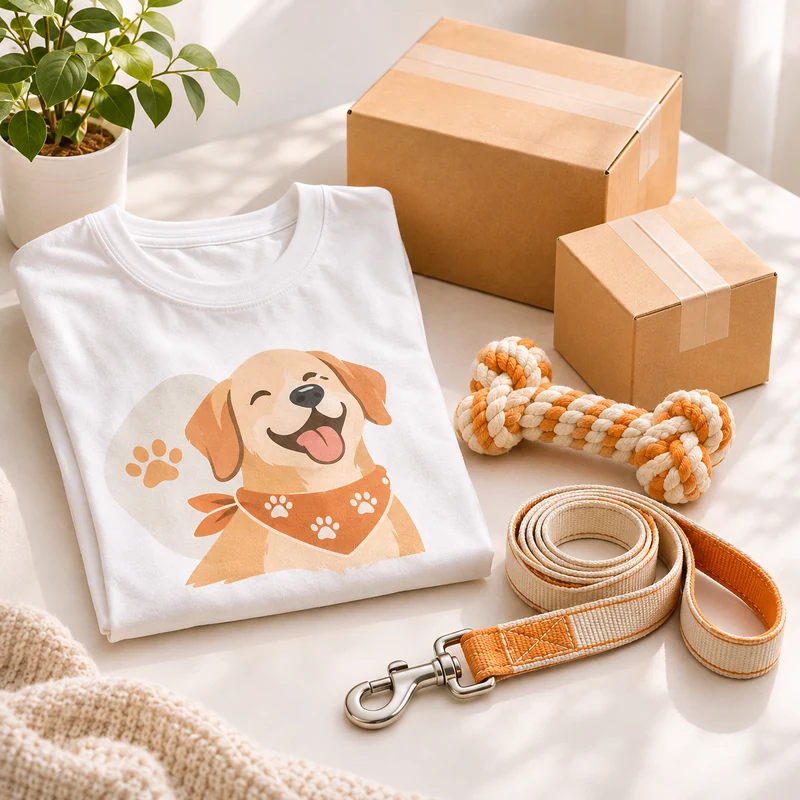
You sell T-shirts featuring your own dog illustrations through a print-on-demand supplier. Alongside them, you offer ready-made pet toys and accessories from a dropshipping supplier.
Now imagine a customer orders a T-shirt and a dog toy together.
The POD supplier prints and ships the T-shirt, while the dropshipping supplier sends the toy separately. Your customer may receive two packages on different days, even though they placed just one order.
That’s something you’ll need to plan for.
Different suppliers may have different shipping costs, processing times, and return policies. Make sure customers know what to expect before they place an order.
As your store grows, you might also decide to keep popular ready-made products in stock rather than ordering them individually from suppliers.
If you’re exploring that option, a sourcing and fulfillment partner like GoShipFulfil can help you discuss product sourcing, packaging, and shipping arrangements for those products. Your POD orders can continue through a separate printing supplier.
Final Thoughts
Print on demand and dropshipping can both be practical ways to start an online business without holding inventory yourself.
The better choice isn’t necessarily the one that looks easier. It’s the one that fits your products, skills, and the customers you want to reach.
Before getting started, compare supplier costs, order samples, and think about the experience your customers will have—from placing an order to receiving their package.
Start small, see what works, and build from there.
Frequently Asked Questions
Can I Start Print on Demand Without Design Experience?
Yes. You don’t need to be a professional designer to start a print-on-demand store.
You can create simple text-based designs, learn basic design tools, or work with a freelance designer. Just make sure you have the right to use any artwork, fonts, or images on products you sell.
Do I Have to Pay the Supplier Before Getting Paid?
You may need to.
In many POD and dropshipping setups, the supplier charges you when an order is submitted for fulfillment. Meanwhile, the money your customer paid may take longer to reach your bank account.
That’s why it’s useful to keep some money available to cover supplier payments, especially when you’re just starting out.
Who Handles Customer Service in Print on Demand and Dropshipping?
You do, in most cases.
Even though a supplier produces or ships the product, customers usually contact your store if an order arrives late, gets damaged, or needs to be returned.
Your supplier may help resolve the issue, but you’re generally responsible for communicating with the customer and following applicable consumer protection rules.