A customer orders a product online, receives it a few days later, and decides to return it. They send the package back. But what happens after it arrives at the warehouse?
Returns management is the process of handling products returned by customers, from receiving and inspecting items to updating inventory and processing refunds or exchanges. It helps ecommerce businesses manage returned products, control costs, and maintain a good customer experience.
The process usually involves several steps, including approving return requests, arranging return shipping, checking product condition, and deciding whether items can be resold.
Not every returned product can go straight back into stock. Some may need to be repaired, replaced, or discarded.
Here’s how ecommerce returns management works and what sellers should consider when handling returned products.
What Is Returns Management?
Returns are a regular part of online shopping, and they can have a significant impact on retail businesses.
According to the 2025 Retail Returns Landscape report by the National Retail Federation (NRF) and Happy Returns, 19.3% of U.S. online sales were expected to be returned in 2025. The report also projected total U.S. retail returns to reach $849.9 billion that year. These figures highlight the importance of having a clear process for handling returned products.
In practice, returns management covers several activities:
- Receiving returned products: Making sure returned items arrive at the correct location.
- Checking product condition: Inspecting products for damage, missing parts, or signs of use.
- Deciding whether items can be resold: Sorting products based on their condition and resale requirements.
- Updating inventory records: Recording which items can return to sellable stock and which cannot.
- Processing refunds or exchanges: Resolving the customer’s return request according to the store’s policy.
For example, a customer may return a skincare product because they no longer need it. Once the item reaches the warehouse, the business needs to check its condition and packaging before deciding what to do with it. If the seal has been opened, it may no longer be suitable for resale.
Returns management is closely related to reverse logistics, which covers the movement of products from customers back through the supply chain.
However, the two terms are not exactly the same. Reverse logistics mainly deals with the movement of returned products, while returns management also covers inspection, inventory updates, and customer service.
How Does the Ecommerce Returns Management Process Work?
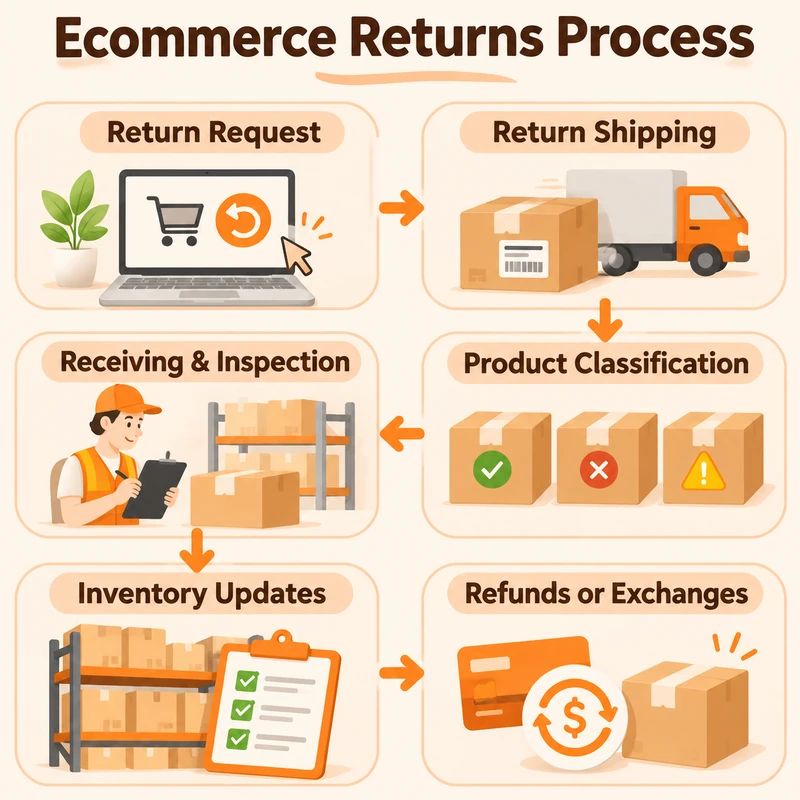
Once a customer requests a return, the business needs to follow a series of steps to handle the product. While the exact process may vary depending on the product and return policy, most ecommerce returns follow a similar path.
1. Return Request and Approval
The process starts when a customer submits a return request.
The business then checks whether the request meets its return policy. For example, some stores allow returns within 30 days, while others have different rules for specific products.
Once the return is approved, the customer receives instructions on how to send the product back.
Some businesses also use a Return Merchandise Authorization (RMA) system. An RMA is a reference number assigned to an approved return. It helps the business track the returned product and match it with the original order.
2. Return Shipping
After approval, the customer needs to send the product back.
Depending on the store’s return policy, the seller may provide a return shipping label or ask the customer to arrange delivery.
The return destination also needs to be considered. Some products may need to go back to the original supplier, while others can be sent to a local warehouse.
For international ecommerce stores, return shipping can be expensive. In some cases, sending a low-cost product back across borders may cost more than the product itself.
That’s why businesses should consider return locations and shipping costs when planning their fulfillment arrangements.
3. Receiving and Inspection
Once the returned package arrives, the warehouse team needs to identify the order and check the product’s condition.
A basic inspection may include:
- Checking the product against the original order
- Looking for visible damage
- Checking the packaging and accessories
- Confirming whether the product has been used
- Deciding whether it meets the requirements for resale
The inspection process depends on the type of product.
For example, a returned travel bag may only need a visual check and a quick inspection of its zippers.
Cosmetics require more careful handling. If the seal has been opened, the product may no longer be suitable for resale.
The goal is to make sure each returned product is properly checked before deciding what happens next.
4. Product Classification
After inspection, each returned product needs to be assigned a status based on its condition.
Not every returned item can go back into sellable inventory. Some may need further checks, while others may need to be repaired or removed from stock.
| Product Condition | Possible Next Step |
| Unopened and suitable for resale | Return to sellable inventory |
| Opened but usable | Review applicable resale and safety requirements |
| Damaged | Repair, return to supplier, or dispose of |
| Unsuitable for resale | Return to supplier, recycle, or dispose of |
The decision should depend on the product’s condition, safety requirements, and applicable regulations.
For example, an unopened household accessory may be suitable for resale after inspection. An opened personal care product may not be.
5. Inventory Updates
After the products have been classified, the inventory records need to be updated.
Items that pass inspection can be added back to available stock. Products waiting for inspection should remain separate from sellable inventory. Damaged or rejected items also need to be recorded correctly.
For example, imagine a store receives ten returned units of the same product. After inspection, seven are approved for resale, while three are found to be damaged.
The inventory system should show seven additional sellable units, not ten.
Keeping these records accurate helps prevent stock errors and gives the business a clearer picture of its available inventory.
6. Refunds or Exchanges
Another important part of the returns process is resolving the customer’s request.
Depending on the store’s return policy and the agreed solution, this may involve:
- Issuing a refund
- Sending a replacement
- Offering an exchange
- Providing another agreed solution
The business should also update the return status and keep the customer informed throughout the process.
Clear communication is important. Customers should know when their returned products have been received and when they can expect a refund or replacement.
This helps avoid confusion and unnecessary follow-up requests.
What Makes Returns Management Difficult for Ecommerce Businesses?
As we’ve seen, handling ecommerce returns involves several steps, from approving return requests to updating inventory and processing refunds. However, having a clear process doesn’t mean everything will always go smoothly. Businesses still need to deal with extra costs, unsellable products, processing delays, and other challenges.
Return Shipping Costs
Shipping a product back adds another transportation cost to the original order.
This can be especially expensive for bulky, heavy, or low-value products. For example, returning a large home accessory may cost more than shipping it to the customer in the first place.
Businesses need to consider where returned products should be sent and who will pay for return shipping. These decisions can have a direct impact on overall fulfillment costs.
Products May No Longer Be Suitable for Resale
A returned product isn’t always ready to be sold again.
Its packaging may be damaged, some accessories may be missing, or the product may have already been used.
Certain product categories also have additional safety and resale requirements. For example, opened cosmetics and some supplement products may no longer be suitable for resale due to hygiene or product safety concerns.
Businesses need to check these requirements before putting returned products back into stock. Otherwise, they may risk sending unsuitable products to another customer.
Delays in Return Processing
Returned products may spend several days in a warehouse while waiting for inspection or further instructions.
During this time, they usually cannot be listed as available stock. If the process takes too long, businesses may miss opportunities to resell products that are still in good condition.
Delays can also make inventory planning more difficult, especially when a store handles a large number of returns.
Poor Return Records
Without accurate return records, businesses may find it difficult to understand why customers are sending products back.
For example, if several customers return the same product because its description doesn’t match the actual item, the problem may be with the product listing rather than the fulfillment process.
Tracking return reasons helps businesses identify recurring issues with product quality, packaging, product descriptions, or suppliers.
Over time, this information can help them make better decisions and reduce avoidable returns.
How to Improve Returns Management
Many of these challenges can be reduced with better planning and a more organized returns process. Businesses don’t need complicated systems to manage returns effectively. Start with clear policies, consistent product checks, and accurate inventory records.
Here are four practical ways to improve returns management.
1. Set Clear Return Policies
Customers should know when they can return products, what conditions apply, and who is responsible for return shipping.
A clear return policy helps customers understand what to expect and reduces unnecessary disputes. It also gives the business a consistent way to handle return requests.
Make sure your policy reflects the products you sell and the consumer protection requirements of your target markets.
2. Standardize Product Inspections
Different products need different inspection requirements. Setting clear standards for each product category makes the process more consistent.
For example, clothing may need to be checked for stains, missing tags, or visible damage. Small electronic products may require additional functional tests.
Having a clear checklist helps warehouse staff inspect returned items and decide whether they are suitable for resale.
3. Keep Inventory Records Updated
Keep items waiting for inspection separate from products that have passed the required checks. Damaged or unsuitable products should also have their own inventory status.
This reduces the risk of sending unsuitable products to customers.
4. Track Return Reasons
Record why customers return their products. Common reasons include:
- Incorrect sizes or specifications
- Damaged products
- Missing accessories
- Products that don’t match their descriptions
- Changes in customer preference
Over time, these records can help businesses identify recurring problems with product quality, packaging, product descriptions, or suppliers.
For example, if several customers report receiving damaged glass bottles, the packaging may need to be improved.
Addressing these issues can prevent similar returns from happening again.
What to Look for in a Returns Management Partner
Managing returns requires time, resources, and clear procedures. For businesses that work with an external fulfillment provider, some parts of the process may also depend on their partner’s capabilities.
However, not every fulfillment provider offers the same return services.
Before making a decision, consider the following questions to understand what support is available and who is responsible for each step.
| What to Check | What to Ask |
| Return Receiving | Can the provider receive returned products? |
| Product Inspection | What types of product checks are available? |
| Inventory Updates | How are returned products recorded? |
| Product Handling | Can unsuitable products be kept separate from sellable stock? |
| Return Shipping | What return destinations and shipping options are available? |
| Communication | How are return updates and product issues reported? |
For ecommerce businesses sourcing products from China, choosing the right partner involves more than arranging product sourcing and order fulfillment. GoShipFulfil can help businesses discuss their sourcing, packaging, and fulfillment requirements.
If you also need support with returned inventory, make sure to confirm whether return receiving, product inspection, and restocking services are available for your specific products and destination.
Before working with any fulfillment provider, make sure both sides understand who is responsible for each part of the returns process.
Final Thoughts
Returns are an unavoidable part of ecommerce, but they don’t have to become a major operational burden.
A well-managed returns process helps businesses control costs, maintain accurate inventory records, and protect customer trust. Return records can also reveal problems with product quality, packaging, and customer expectations.
The goal isn’t to eliminate every return. It’s to handle them efficiently, make informed inventory decisions, and provide customers with a clear and reliable return experience.