
When running an online store, product costs and shipping fees are usually easy to notice. Storage costs are different. They can build up quietly while products sit in a warehouse waiting for orders.
For growing ecommerce businesses, this can become a problem. More inventory often means more storage space, but having more stock doesn’t always lead to more sales.
Ecommerce storage costs are the expenses of keeping products in a warehouse before they are sold and shipped. They mainly depend on inventory size, storage time, SKU count, warehouse location, and the provider’s pricing method.
Understanding these costs is important when deciding how much inventory to hold, where to store it, and which fulfillment arrangement makes sense for your business.
So, what affects warehouse storage fees, and how can sellers keep them under control?
What Are Storage Costs in Ecommerce?
Before looking at what affects storage fees, let’s first understand what these costs include.
Storage costs are the expenses involved in keeping products in a warehouse or another storage facility before they are sold and shipped.
For ecommerce businesses, these expenses may include:
- Warehouse space or storage fees
- Inventory storage management
- Special storage requirements
- Long-term storage surcharges
- Other storage-related charges
When working with a third-party logistics provider (3PL), storage is usually charged separately from other fulfillment services.
For example, a 3PL may charge for receiving incoming products, storing them on shelves or pallets, picking items for customer orders, and shipping the finished packages.
These are different services, so they may appear as separate charges on your invoice.
Understanding each cost helps you avoid comparing fulfillment providers based only on their advertised storage rates.
What Factors Affect Storage Costs?
Several factors determine how much warehouse space your inventory needs and how much you pay to store it.
Not every product takes up the same amount of warehouse space or stays there for the same length of time.
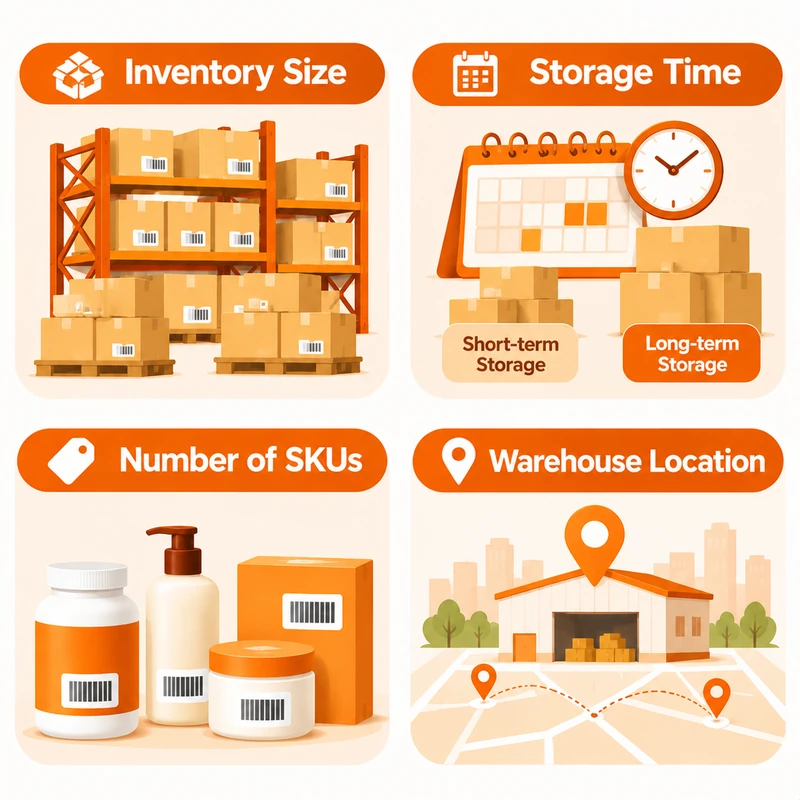
1. Inventory Size and Storage Space
The amount of space your products occupy is one of the main factors affecting storage costs.
Warehouses commonly offer different storage options, such as bins, shelves, and pallets.
For example:
- Bins: Suitable for smaller products and individual items.
- Shelves: Useful for products that need organized storage and easy access.
- Pallets: More suitable for larger quantities of boxed or bulk inventory.
A small skincare bottle may fit into a bin, while a large carton of home products may require pallet storage.
The more space your inventory occupies, the more you may need to pay.
2. How Long Products Stay in Storage
Storage time matters just as much as storage space.
A product that sells within a few days may generate fewer storage charges than one that remains in the warehouse for several months.
Some 3PL providers charge monthly storage fees, while others calculate charges based on actual storage time.
For example, if a provider offers prorated billing, you may only pay for the days your inventory occupies a storage location rather than a full month.
Before choosing a provider, check how storage periods are calculated and whether long-term storage surcharges apply.
3. Number of SKUs
A SKU (Stock Keeping Unit) is a unique identifier used to track a specific product or product variation.
A store selling one type of water bottle in three colors may have three different SKUs.
As your product range grows, inventory organization can become more complicated.
Some warehouses charge based on the storage locations occupied by inventory, while others use volume-based pricing. The number of SKUs may also affect storage arrangements, depending on how the warehouse organizes and charges for inventory.
A business with many slow-moving product variations may face additional storage or inventory management costs, depending on how the warehouse organizes and charges for each SKU.
4. Warehouse Location
Where your inventory is stored can also affect your overall expenses.
Warehouse rates vary depending on the location, available space, labor costs, and local operating expenses.
For example, storing products near a major city may provide access to a larger customer base and faster delivery options, but warehouse space may cost more.
The cheapest storage location isn’t necessarily the most cost-effective choice.
You also need to consider how warehouse location affects shipping expenses and delivery times.
How Do 3PL Providers Calculate Storage Fees?
Once you understand what affects storage costs, the next step is to look at how 3PL providers calculate them.
Different fulfillment providers use different pricing models.
Understanding these models makes it easier to compare quotes.
| Storage Method | How It Works | Suitable For |
| Per Bin | Charged for each storage bin used | Small products |
| Per Shelf | Charged for each shelf occupied | Medium-sized inventory |
| Per Pallet | Charged for each pallet position | Bulk inventory |
| Per Cubic Foot | Based on the volume occupied | Businesses with varied product sizes |
| Per Unit or SKU | Based on stored product quantities or specific SKU arrangements | Depends on the provider’s pricing model |
Some providers also use a combination of these methods.
For example, a warehouse may charge separately for receiving inventory and storing it on pallets.
It’s important to understand exactly what each quote includes.
A low monthly storage rate may not represent the lowest total cost if additional handling or long-term storage fees apply.
For a broader look at the different charges involved in third-party logistics, see our guide to fulfillment costs.
Why Do Storage Costs Increase?
Understanding what affects storage fees is one thing. But what actually causes these costs to increase over time?
A growing business doesn’t necessarily need to spend more on storage every month.
In many cases, rising expenses come from how inventory is managed rather than simply how much the business sells.
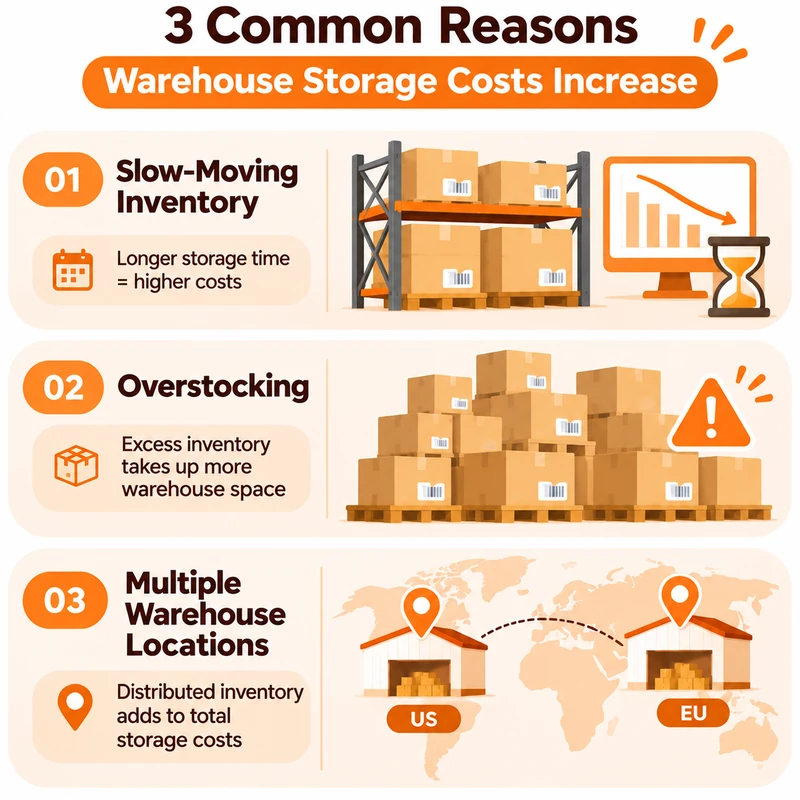
Slow-Moving Inventory
Products that sell slowly can occupy valuable warehouse space for extended periods.
Imagine a store holding 500 units of a seasonal product, but only selling 50 units each month.
Most of that inventory will remain in storage for several months.
If the product doesn’t sell as expected, the business continues paying to store items that are not generating revenue.
Reviewing product sales and inventory movement can help identify these situations early.
Overstocking
Buying larger quantities may reduce the purchase price per unit, but it can also increase storage expenses.
For example, purchasing 1,000 units instead of 300 may provide a better supplier price.
However, if demand is lower than expected, the remaining products may occupy warehouse space for much longer.
The lower purchasing price doesn’t automatically make the larger order more profitable.
Multiple Warehouse Locations
Some ecommerce businesses distribute inventory across several warehouses to serve customers in different regions.
This can reduce delivery distances, but it may also increase storage expenses.
For example, storing the same product in warehouses in the US and Europe means maintaining separate inventory in both locations.
The additional storage expense should be compared with potential savings in transportation and delivery time.
How to Reduce Ecommerce Storage Costs
Once you understand what causes storage costs to increase, the next step is to find ways to keep them under control.
Reducing storage costs doesn’t always mean moving products into a smaller warehouse.
The better approach is to make sure your inventory uses storage space efficiently.
Here are four areas worth reviewing.
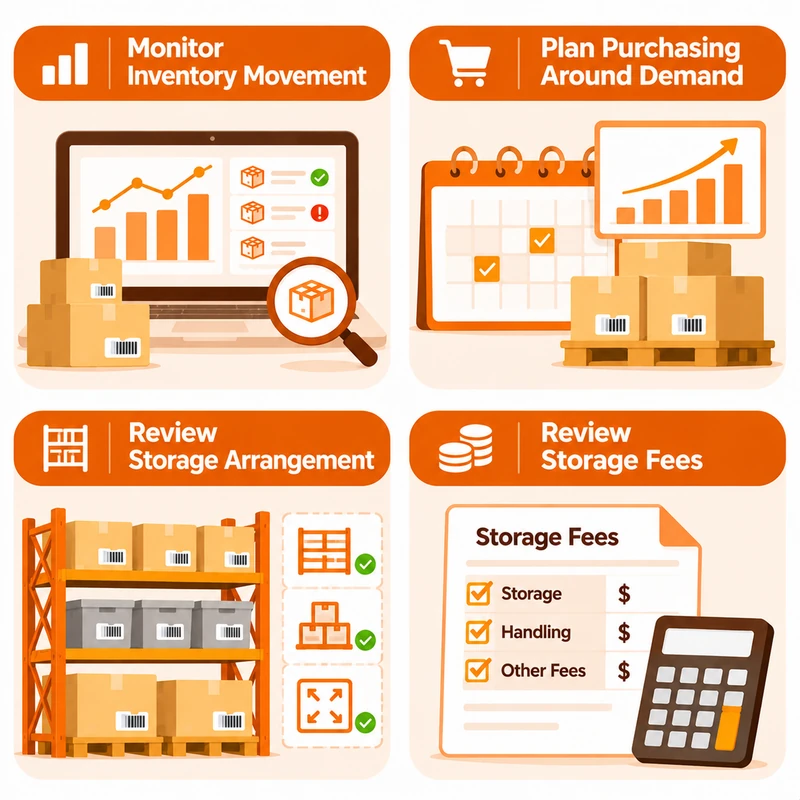
1. Monitor Inventory Movement
Track how quickly individual products sell.
Products with consistent demand are easier to plan for, while slow-moving products may require smaller purchasing commitments.
This helps prevent warehouse space from being occupied by products that are unlikely to sell soon.
2. Plan Purchasing Around Actual Demand
Avoid ordering large quantities simply because a supplier offers a lower unit price.
Instead, consider sales history, expected demand, supplier lead times, and available storage space.
For example, a new product with uncertain demand may be better suited to a smaller initial order.
Once sales become more predictable, you can adjust purchasing quantities.
3. Review Your Storage Arrangement
Check whether your products are stored in the most suitable locations.
Small products may not need pallet storage, while bulky products may take up too much room on individual shelves.
You should also review whether every product variation needs to be stored in the same warehouse.
A more suitable storage arrangement can help reduce unnecessary space usage.
4. Review Storage Fees Regularly
Don’t wait until storage invoices become expensive before reviewing your arrangement.
Check the following details:
- Monthly storage rates
- Long-term storage surcharges
- Receiving and handling fees
- Billing periods and prorated charges
- Additional fees for special storage requirements
Comparing these details helps you understand the actual cost of storing inventory rather than relying on a single advertised rate.
Final Thoughts
Storage costs are an important part of ecommerce operations, but they shouldn’t be treated as a fixed expense that businesses simply have to accept.
Inventory size, storage time, SKU count, warehouse location, and product demand all influence how much you pay.
By monitoring inventory movement and planning purchases carefully, sellers can avoid unnecessary storage expenses while keeping enough products available for customer orders.
When reviewing a fulfillment arrangement, look beyond the monthly storage rate. Consider how purchasing, storage, and order fulfillment work together.
A cost-effective storage strategy should support your sales rather than tie up too much money in products that aren’t moving.
If you’re reviewing your current fulfillment arrangement, GoShipFulfil can help you explore inventory storage, product sourcing, and fulfillment options based on your business needs.