A supplement sold in the U.S. might not meet the requirements for sale in Canada or Europe.
The ingredients could be the same. The packaging might look the same too. But what works in one market doesn’t always work in another.
If you want to try supplement dropshipping, this is one more thing to think about. Finding a supplier and opening an online store is only the first step. You also need to check if your products meet the rules in each country you want to sell to.
So what should you know before you sell your supplements in other countries?
In this guide, we’ll look at supplement rules in five major markets. We’ll also share what sellers should check before expanding abroad.
What Is Supplement Dropshipping?
Supplement dropshipping is a way to sell dietary supplements without keeping the products in your own warehouse.
When a customer places an order, your supplier or fulfillment partner prepares and ships the product.
You manage the online store, product listings, marketing, and customer service.
For example, you might sell vitamin gummies through a Shopify store. When someone buys a bottle, your supplier ships it directly to the customer.
This model can reduce the need to buy large amounts of inventory upfront.
However, dropshipping does not remove your responsibilities as a seller. You still need to check product safety, labels, and local sales rules.
Why Do Supplement Regulations Differ by Market?
Countries don’t always classify supplements the same way.
A product may be a dietary supplement in one country. In another country, it may be treated as a health product or a medicine.
Each market may also have different rules for ingredients, labels, and health claims.
Products may also make claims about their health benefits. For example, a label might say that a supplement supports normal immune function. Different countries may classify and regulate these claims differently.
Even if a claim is supported by science, it may not be allowed in every market.
This means a supplier’s existing product label may not work everywhere.
Before you list a product, you need to know the rules of the country where your customer lives.
Supplement Dropshipping Regulations by Market
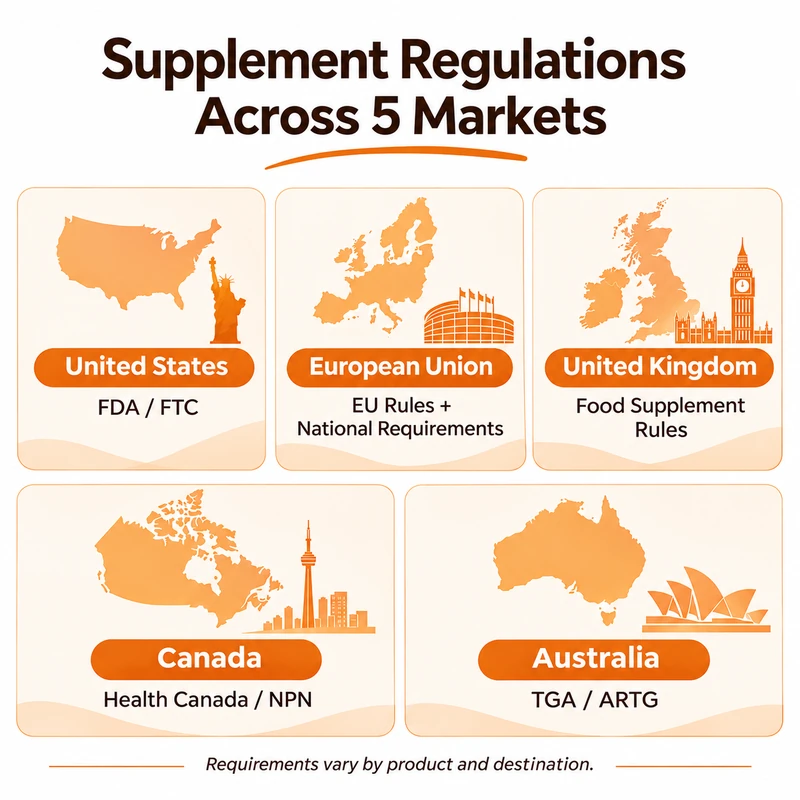
Here are the main differences sellers should know when targeting the United States, European Union, United Kingdom, Canada, and Australia.
1. United States: FDA Requirements
In the US, the Food and Drug Administration (FDA) is in charge of dietary supplements.
Most supplements don’t need FDA approval before they’re sold. But you still have to follow the rules.
These include:
- Manufacturing standards: Manufacturers must follow applicable current Good Manufacturing Practice (cGMP) rules.
- Product labels: Labels usually need a Supplement Facts panel and an ingredient list, plus a few other details.
- Product claims: Claims must be truthful and follow applicable FDA and FTC rules.
- New dietary ingredients: Certain new dietary ingredients require notification to the FDA before marketing.
Let’s say you want to sell a magnesium supplement in the US.
Your supplier may already have a finished product. But you should still check the label and ingredient list yourself.
A facility registered with the FDA doesn’t mean the supplement is FDA-approved. Most supplements aren’t approved by the FDA at all.
Before you list the product, ask your supplier for the full label, manufacturing information, and key quality documents.
2. European Union: Shared Rules, Local Differences
The European Union has common rules for food supplements.
These rules cover things like permitted vitamins and minerals, labeling, and health claims.
But some requirements are still different between EU countries.
For example, some countries ask businesses to notify the local authorities before a food supplement is sold.
So a product sold in Germany may need extra checks before it is sold in France.
The EU also has strict rules for health claims.
You can only use claims that are allowed under EU rules. You must also meet the conditions for using them.
For each target country, review the ingredients, label language, permitted claims, and any local notification rules.
3. United Kingdom: Food Supplement Rules
In the UK, many supplements are regulated as food, not medicine.
They must follow the food safety and labeling rules that apply.
For example, labels generally need an ingredient list, recommended daily intake, relevant warnings, and business details.
Sellers must also avoid unauthorized medical claims.
There is one more detail to know.
Great Britain and Northern Ireland don’t always follow the same food rules. Northern Ireland has special arrangements linked to EU food law.
For example, a label made for sale in England may need more review before the product is sold in Northern Ireland.
Before selling, confirm the product’s classification, label details, and health claims. Also check the rules for the part of the UK where you will sell it.
4. Canada: Natural Product Numbers
Canada uses a different system for many supplements.
Vitamins, minerals, and herbal supplements often count as Natural Health Products (NHPs).
These products usually need a licence from Health Canada before they can be sold.
An approved product gets a Natural Product Number (NPN).
You can usually find this eight-digit number on the label.
For example, a vitamin supplement sold in the US can’t automatically be sold to Canadian customers.
Even if the ingredients look familiar, you need to confirm that the product has the right Canadian approval.
What sellers should check: Ask for the product’s NPN and check it in Health Canada’s official database. Also check the labeling rules and confirm whether the importer has the required Site Licence.
5. Australia: TGA and Product Listing
Australia has its own regulatory system.
Many supplements are classified as complementary medicines. They are regulated by the Therapeutic Goods Administration (TGA).
Most complementary medicines sold in Australia must be on the Australian Register of Therapeutic Goods (ARTG), unless an exemption applies.
Many lower-risk listed medicines show an AUST L number on the label.
For example, a herbal supplement may be available from an overseas supplier. That doesn’t mean it can be sold to Australian customers.
You still need to check the ingredients, product claims, and regulatory status.
There are a few things you need to check. Confirm if the product is regulated as a therapeutic good and if it needs an ARTG entry. Also check the product number and the import rules.
What Should Sellers Check Before Choosing a Market?
The rules may seem complicated, but you can start with a few practical questions.
| What to Check | Why It Matters |
| Product classification | A supplement may be treated differently across markets |
| Ingredients | Some ingredients may be restricted or subject to special conditions |
| Product authorization | Certain markets require a licence or listing |
| Labeling | Required information and languages may differ |
| Health claims | Not every marketing statement is allowed everywhere |
| Import requirements | A product may face restrictions when entering a country |
Start with one market instead of trying to sell everywhere at once.
For example, if most of your customers are in the US, focus on products that meet US requirements first.
Once your store is operating well, you can review the rules for another market.
This approach makes supplier communication and product checks easier to manage.
How to Choose a Supplement Dropshipping Supplier
A supplier may offer hundreds of supplement products. But a big catalog doesn’t tell you which products suit your market.
Before you choose a supplier, ask for the information you need to review the products properly.
Start with the basics: product specifications, full ingredient lists, labels, and manufacturing details.
You can also ask for a Certificate of Analysis (COA).
A COA is a document that shows test results for a product or a batch. For example, it may show results for certain ingredients or contaminants.
But a COA is not a product licence. It also doesn’t prove that a supplement meets every rule in your target market.
Ask the supplier which markets the product is made for. Then check the supporting documents.
You should also confirm if the supplier can ship single orders.
Some supplement manufacturers only make bulk orders. They may not ship directly to consumers.
Planning Supplement Fulfillment Across Markets
Once you’ve picked your products and supplier, it’s time to think about shipping.
Getting supplements to customers isn’t just packing and sending orders. Storage, packaging, and expiration dates matter too.
Take gummies, for example. Some don’t handle heat well. If they get too hot in storage or during shipping, their quality can change.
You also need to record batch numbers and expiration dates. This helps you track which product batches were sent to customers.
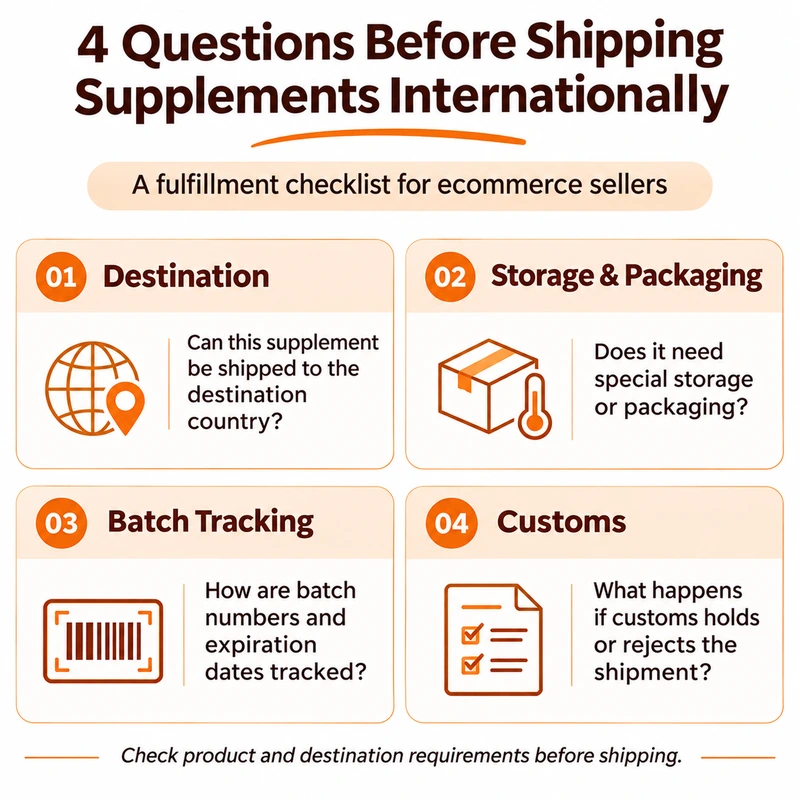
Before you ship internationally, ask your fulfillment partner a few questions:
- Can you ship this supplement to the country I want to sell in?
- Does it need special packaging or storage?
- How do you track batch numbers and expiration dates?
- What happens if customs holds or rejects the package?
A shipping service may deliver to a country. But that doesn’t mean every supplement can legally be imported or sold there.
Your supplier and fulfillment partner need to work together. That helps you avoid order problems.
If you work with several suppliers, a service provider like GoShipFulfil can help you talk through sourcing, packaging, and fulfillment in one place.
Before you send any supplement overseas, always check the product and the rules for its destination.
Final Thoughts
Want to enter the wellness market without running your own warehouse? Supplement dropshipping can make that possible.
But selling across borders needs careful planning.
The US, EU, UK, Canada, and Australia each have their own supplement rules. A product that is ready for one market may need different labels, documents, or authorization in another.
So begin with your target market. Check what rules the product needs to meet. Then choose a supplier who can give you the right information.
Good fulfillment is important. But it comes second. First, make sure you can legally sell and ship the product.